The Quiet Power of the Whisk: How Matcha Preparation Rewires Your Mind Better Than Any App

Photo by Photo by Zed Can on Unsplash on Unsplash
The App Won't Save You
America spends over two billion dollars a year on meditation and mindfulness applications. Guided breathing exercises arrive via push notification. Ambient soundscapes are curated by algorithm. Calm reminders interrupt the very device that created the anxiety they promise to resolve. And yet, by nearly every available measure, chronic stress and attentional fragmentation continue to climb.
This is not an indictment of digital wellness tools. Many people derive genuine benefit from them. But there is a growing body of evidence suggesting that the most reliable path to a quieted mind is not passive consumption of guided audio—it is deliberate, rhythmic, physical engagement with the immediate world. In other words, doing something with your hands.
Matcha preparation, practiced with intention and proper technique, may be precisely that something.
What the Neuroscience of Repetitive Movement Actually Tells Us
The brain's default mode network—the neural system responsible for mind-wandering, rumination, and the particular brand of low-grade dread that characterizes modern life—is most effectively quieted not by stillness alone, but by focused, patterned physical activity. Researchers studying everything from knitting to pottery to tai chi have documented measurable reductions in cortisol, increased alpha-wave activity, and elevated production of serotonin in participants engaged in repetitive, intentional movement.
The mechanism is straightforward: when the body performs a learned, rhythmic task that demands mild but continuous sensory attention, the prefrontal cortex narrows its focus. The cognitive bandwidth that would otherwise fuel anxious thought loops is redirected toward the kinesthetic experience at hand. Psychologists sometimes call this "flow-adjacent" state—not the full absorption of deep flow, but a reliable threshold of present-moment engagement that interrupts the cycle of rumination.
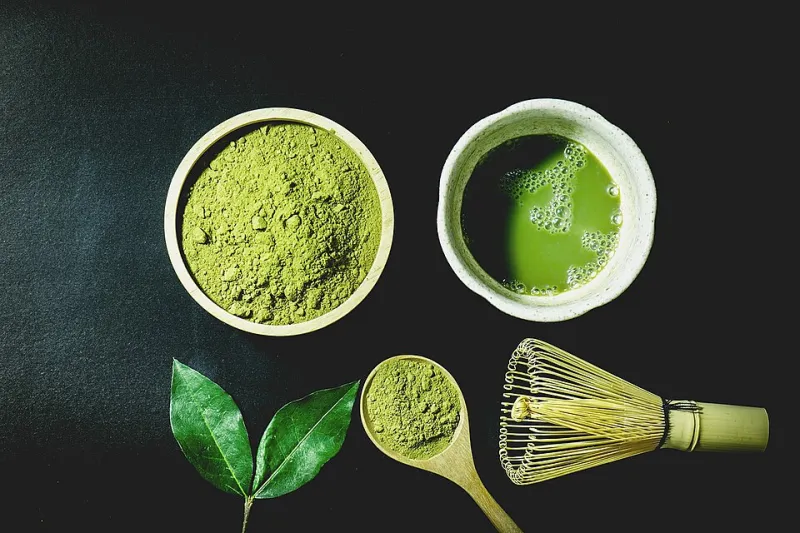
Whistling matcha with a bamboo chasen fits this profile with unusual precision. The circular, wrist-driven motion is repetitive but not mindless. The resistance of the liquid changes as the powder hydrates. The color shifts from pale green to a vibrant, frothy jade. The sound—a soft, papery hiss against ceramic—provides continuous auditory feedback. Every sensory channel is gently occupied.
Why the Hands Matter More Than We Acknowledge
There is a reason the Japanese tea ceremony, chado, has endured for over five centuries as a contemplative discipline rather than simply a method of beverage preparation. Its founders understood something that Western wellness culture has been slow to rediscover: the hands are not merely instruments of the mind. They are, in a meaningful neurological sense, an extension of it.
The human hand contains one of the densest concentrations of sensory nerve endings in the body. Engaging those nerve endings in a purposeful task sends a continuous stream of proprioceptive data to the brain—information about texture, temperature, resistance, and position. This stream serves as a natural tether to the present moment, one that is far more difficult to ignore than a recorded voice asking you to notice your breath.
When you hold a ceramic chawan, feel the warmth of water at the correct temperature (approximately 175°F for ceremonial-grade matcha), and draw the chasen through the bowl in controlled, deliberate strokes, you are not simply making tea. You are providing your nervous system with a structured, embodied experience of now.
The Contrast With Passive Wellness
Consider the typical interaction with a mindfulness application. You open your phone—the same device that delivered your last stressful email—navigate to an app, select a session length, insert earbuds, close your eyes, and attempt to follow a stranger's voice into a state of relaxation. The entire process requires you to passively receive an experience designed by someone else, mediated by technology, and delivered through the same sensory channel—screen and speaker—that generates most of your daily cognitive load.
Matcha preparation inverts this entirely. You are the agent. The process unfolds through your physical participation, not despite it. There is no correct way to feel, no narrator telling you that your mind has wandered. There is only the bowl, the powder, the water, and the whisk—and the unambiguous sensory feedback that tells you whether you are present or not. If your attention drifts and your wrist stiffens, the foam collapses. The practice is self-correcting in a way no app can be.
This is not a minor distinction. It is the difference between being guided toward presence and being required to inhabit it.
Building the Practice: What Intentional Preparation Actually Looks Like
The ritual does not require an elaborate setup or hours of free time. What it does require is a decision to treat the preparation as the practice itself, rather than a means to an end.
Begin by sifting one to two grams of high-quality ceremonial-grade matcha into a prewarmed bowl. The sifting step is not optional theater—it is the first act of attention, an invitation to notice the powder's color, its faint vegetal fragrance, the way it falls through the mesh. Add water that has been heated and allowed to rest briefly below boiling. Observe the first contact between liquid and powder.
Then whisk. Use a genuine bamboo chasen, not a battery-powered frother. The chasen's tines flex and spring against the bowl's surface in a way that transmits information back through your fingers. Move from the wrist, not the elbow. Let the motion find its own rhythm—brisk but not aggressive, consistent but not mechanical. Watch the surface of the liquid transform. Listen to it.
When the foam reaches the surface in a fine, uniform layer, pause. Hold the bowl in both hands. Feel its weight and warmth. Drink without distraction.
From sift to first sip, the process takes under five minutes. In those five minutes, your default mode network will have had fewer opportunities to generate catastrophic projections about your quarterly review or your unanswered messages than it would during five minutes of passive audio meditation. The reason is simple: your hands were busy doing something real.
A Practice America Already Has Everything It Needs For
The United States does not lack access to matcha. It does not lack chasen, chawan, or the two minutes required to heat water to the correct temperature. What it has lacked, until recently, is the cultural framework that treats the preparation of tea as worthy of the same seriousness it affords a yoga class or a journaling session.
That framework exists. It has existed in Japan for centuries. It is available to anyone willing to approach a bowl and a whisk with the same intentionality they would bring to a guided meditation—and, as the neuroscience increasingly suggests, it may deliver something more immediate, more embodied, and more difficult to scroll past.
The mindfulness practice America got wrong was never really about the app. It was always about the hands.