Five Minutes, Full Presence: Weaving Japanese Tea Ceremony Principles Into Your Daily Routine
Somewhere between a 7 a.m. conference call and a packed school drop-off schedule, the idea of a traditional Japanese tea ceremony can feel like a beautiful artifact from another world. The classical chanoyu unfolds over hours, guided by precise choreography, seasonal flower arrangements, and a silence that most American households would find extraordinary. And yet the soul of that ceremony—its insistence on full attention, its transformation of the ordinary into the sacred—is not a luxury reserved for Kyoto tea masters. It is, in fact, a practice that fits inside the margins of a busy life, if you know where to look.
At Kagura Matcha, we believe that authentic matcha is not merely a beverage ingredient. It is an invitation. Every tin of ceremonial-grade powder carries within it a lineage of mindful preparation, and understanding even a fraction of that lineage changes how you approach the bowl.
What the Ceremony Is Actually Teaching
Before adapting anything, it helps to understand what you are adapting from. The tea ceremony, codified largely by the sixteenth-century tea master Sen no Rikyu, rests on four principles: wa (harmony), kei (respect), sei (purity), and jaku (tranquility). These are not decorative concepts. They are functional instructions for how to occupy a moment.
Harmony asks that you meet your environment as it is—the noise, the light, the particular quality of a Tuesday morning—rather than wishing it were otherwise. Respect extends to the tools you use, the water you heat, and the person you are serving, even if that person is yourself. Purity refers less to physical cleanliness than to a cleared mental state, a deliberate setting-aside of what came before and what comes next. Tranquility emerges naturally when the first three are honored.
None of these require a quiet room or an hour of free time. They require intention, which is portable.
Start With the Water
In classical ceremony, water is treated with near-reverent care. Its temperature, its source, the sound it makes as it enters the bowl—all of it matters. This is not precious behavior. Water temperature genuinely affects how matcha behaves: water above 175°F can make even high-quality powder taste bitter, while water around 160–170°F draws out its natural sweetness and umami depth.
The practical adaptation here is simple: heat your water deliberately. Whether you use a temperature-controlled kettle or simply let boiling water rest for two minutes, make that waiting a conscious act rather than an interruption. Set down your phone. Notice the steam. This single pause, inserted before you even reach for the whisk, is already ceremony.
The Whisk as Anchor
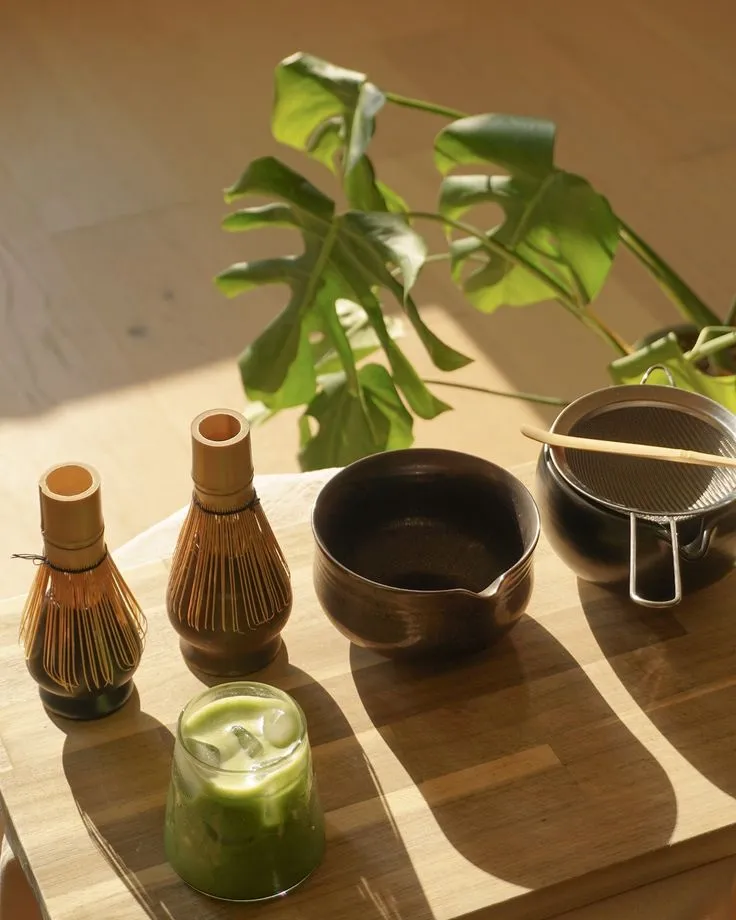
The chasen, or bamboo whisk, is the most recognizable tool of the tea ceremony, and it is also the most instructive one for modern practitioners. Whisking matcha properly—using a rapid W or M motion rather than a circular stir—produces the fine foam that signals a well-prepared bowl. More importantly, it requires your hands, your attention, and approximately sixty seconds of focused physical engagement.
In a world where most of our interactions with technology are passive—scrolling, watching, listening—whisking is refreshingly active. Your body is doing something deliberate. Neuroscientists who study embodied cognition note that repetitive, rhythmic physical tasks can lower cortisol and shift the nervous system toward a calmer baseline. The tea masters of feudal Japan may not have used that vocabulary, but they understood the principle intuitively.
If you own a chasen, rinse it in warm water before use to soften the tines and extend its life. If you are working with a small electric frother as a starting point, use it mindfully—attend to the motion, the sound, the color shift as the powder integrates. The tool matters less than the quality of attention you bring to it.
Choose Your Vessel With Care
Traditional tea bowls, called chawan, are often asymmetrical, rough-textured, and deliberately imperfect—an expression of the aesthetic philosophy known as wabi, which finds beauty in the humble and the incomplete. You do not need to source a hand-thrown ceramic piece from a Japanese artisan (though Kagura Matcha does carry a curated selection worth exploring). What you do need is a vessel that you have chosen consciously.
A wide, low mug works far better than a tall, narrow one—it gives your whisk room to move and allows the foam to develop properly. More than function, though, consider how the object feels in your hands. The ceremony tradition of mochikomi, or the handling of objects with full awareness, suggests that the tactile experience of your bowl is not incidental. It is part of the practice.
If your current mug feels like a placeholder, consider it an invitation to find something that does not.
The Sacred Pause Before the First Sip
Perhaps the most transferable element of chanoyu is what happens just before drinking: a moment of stillness, a slight bow of the head, an acknowledgment that something is being received. In the formal ceremony, guests rotate the bowl to avoid drinking from its front face—a gesture of respect for the craftsperson who made it. In your kitchen at 7:15 a.m., the equivalent might simply be holding the bowl with both hands, looking at the surface of the matcha, and taking one slow breath before you drink.
This is not a spiritual requirement. It is a neurological reset. Research on mindful eating and drinking consistently shows that brief moments of sensory attention before consuming something—noticing color, aroma, temperature—activate the prefrontal cortex and reduce the likelihood of consuming on autopilot. The ceremony knew this, in its own language, four hundred years before the neuroscience caught up.
Building a Five-Minute Framework
Put together, a ceremony-informed matcha practice might look like this: heat water with intention (two minutes), sift your matcha and whisk with focus (ninety seconds), hold the bowl and pause (thirty seconds), and drink slowly, without a screen in front of you (remaining time). That is five minutes. It is also, in every meaningful sense, a ritual.
You do not need to perform it perfectly. You do not need to know the names of the ceremony's movements or own a fukusa cloth. What you need is the willingness to treat those five minutes as genuinely different from the rest of your day—not a task to complete, but a practice to inhabit.
The ceremony has always been less about the tea than about the person preparing it. That truth does not diminish with a busy schedule. If anything, it becomes more valuable.
When you are ready to begin, begin with the best matcha you can find. The rest follows from there.