Beginner's Fortune: The Counterintuitive Reason New Matcha Drinkers Often Feel More
There is a quiet irony that surfaces repeatedly in conversations among matcha enthusiasts. The person who discovered matcha three weeks ago cannot stop talking about it — the clarity, the steadiness, the sense that mornings finally make sense. Meanwhile, someone who has prepared a bowl every day for three years nods politely, remembering a feeling that has gradually become harder to locate. The beginner is experiencing something the veteran is chasing.
This is not coincidence. It is neuroscience, psychology, and ritual science converging in a cup of whisked green powder. Understanding why it happens — and what can be done about it — is one of the more practically useful things a matcha drinker can learn.
The Neuroscience of Novelty
The human brain is, at its core, a prediction machine. It continuously models the world based on past experience, and when reality matches its predictions, it conserves resources by dampening its response. This mechanism, known as neural habituation, is why the smell of your own home becomes invisible to you within minutes of walking through the door, and why the first bite of a meal almost always tastes better than the last.
When someone encounters matcha for the first time, the brain has no established model for it. The L-theanine and caffeine combination — which produces the characteristically grounded alertness that distinguishes matcha from coffee — registers as genuinely novel. The brain pays attention. Dopaminergic pathways associated with reward and learning are more active during novel experiences, which amplifies the perceived effect of a stimulus even when the stimulus itself remains constant.
In practical terms, this means a newcomer consuming 70 milligrams of caffeine and 35 milligrams of L-theanine in a ceremonial-grade bowl is neurologically primed to notice every nuance of that experience. A seasoned practitioner consuming the identical compounds may register comparatively little — not because the compounds are working less effectively at a biochemical level, but because the brain has built an efficient, low-attention model for the experience.
The Expectation Variable
Neuroscience has established that expectation shapes perception in ways that are neither trivial nor purely psychological. Placebo research has demonstrated measurable physiological changes — including altered neurotransmitter activity — driven entirely by expectation. For a new matcha drinker who has read about L-theanine's role in promoting alpha brain wave activity, or who has been told by a trusted friend that matcha changed their mornings, the expectation itself becomes part of the therapeutic mechanism.
This is not deception. It is biology. The anticipatory dopamine release that occurs when someone expects a positive outcome primes the nervous system to receive that outcome more fully. Beginners, by definition, carry this priming into every early encounter with matcha. Long-term practitioners, having accumulated hundreds of confirmed predictions, carry something different: familiarity.
Familiarity is comfortable. It is also, neurologically speaking, a dampener.
What the Veteran Loses — and Gains
It would be a mistake to frame habituation as purely a loss. The experienced matcha practitioner has developed something the newcomer lacks entirely: a refined sensory vocabulary. A beginner may feel a general sense of wellbeing without being able to locate its source. A veteran can distinguish between the specific texture of umami in a first-harvest Uji matcha and the brighter, more grassy character of a Nishio blend. They notice when their whisk technique has produced a finer foam. They understand the difference between a practice that feels mechanical and one that feels genuinely inhabited.
The problem arises when that sophistication is mistaken for diminishing returns. Veterans often interpret habituation as evidence that matcha is no longer working — when in truth, it is working precisely as expected, which is to say quietly, efficiently, and without fanfare.
Micro-Challenges as a Reset Mechanism
The most effective strategy for long-term practitioners is not to abandon the practice but to deliberately introduce structured novelty. Small, intentional disruptions to the established ritual can reactivate the brain's attentional systems without requiring a complete overhaul of one's relationship with matcha.
Consider the following approaches:
Change the vessel. Preparing matcha in an unfamiliar bowl — even temporarily — forces the hands and eyes to recalibrate. The ritual becomes slightly effortful again, which is precisely the condition under which attention returns.
Shift the origin. A practitioner accustomed to Uji-region matcha might spend a month exploring Kagoshima or Aichi expressions. Different terroir, different harvest timing, and different cultivars produce distinct flavor profiles that demand fresh attention.
Alter the preparation method. Preparing a cold-whisked matcha on a warm summer morning, or experimenting with a koicha-style thick preparation, reintroduces procedural novelty that interrupts automatic behavior.
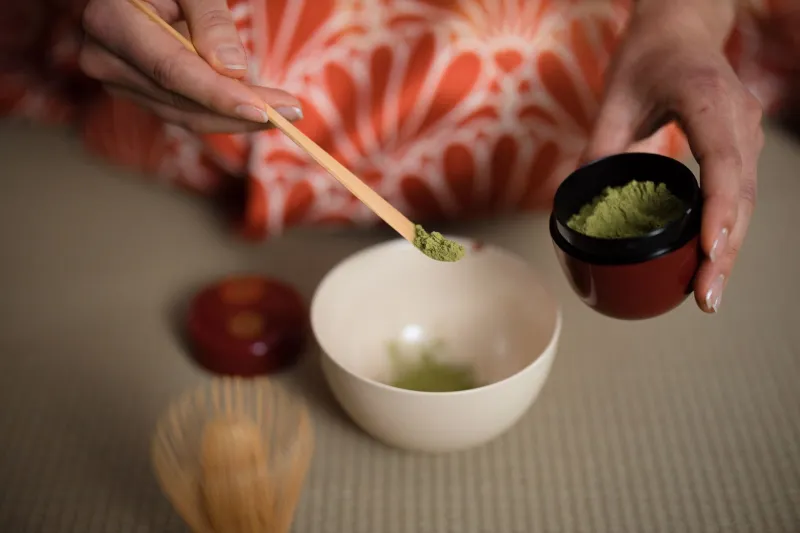
Observe without consuming. Spending one preparation session focused entirely on the sensory experience of whisking — the sound of the chasen against ceramic, the transformation of powder into liquid — without evaluating the taste can restore attentional presence.
Introduce a deliberate pause. Some practitioners find that a planned three-to-seven-day break from matcha, followed by a mindful return, produces a meaningful reset. The hiatus is not a failure of commitment; it is a strategic use of neurological contrast.
The Beginner as Teacher
There is something instructive about spending time with someone who is new to matcha. Their enthusiasm is not naivety — it is access. They are experiencing the practice with a permeability that familiarity gradually forecloses. Rather than regarding a newcomer's excitement with gentle condescension, the experienced practitioner might consider what it would mean to approach the next morning's bowl with even a fraction of that openness.
The Japanese concept of shoshin, or beginner's mind, has been discussed in Zen contexts for centuries. It describes the quality of approaching a familiar subject without the preconceptions that expertise accumulates. In the context of a daily matcha practice, it is less a philosophical ideal than a practical neurological target: the deliberate suspension of the brain's predictive efficiency in order to restore genuine engagement.
Reclaiming the Original Encounter
No practitioner can return to their first bowl. That particular neurological moment is, by definition, unrepeatable. But the conditions that made it vivid — attention, novelty, expectation, presence — are not permanently beyond reach. They can be cultivated, deliberately and repeatedly, through the kinds of intentional disruptions described above.
The matcha paradox, ultimately, is not a problem to be solved so much as a cycle to be understood. Beginners feel more because they are paying attention. Veterans feel less because attention has given way to automation. The path forward is not to wish for beginner status but to reconstruct, through effort and intention, the conditions under which the practice first revealed itself.
The bowl has not changed. The question is whether the person holding it is still genuinely present with it.