Three O'Clock and Falling Apart: What Your Afternoon Energy Crash Is Actually Telling You

The 3pm Wall Is Not Inevitable
Most Americans treat the afternoon energy crash as an unavoidable fact of working life — something to be managed with a second cup of coffee, a sugary snack, or sheer willpower. Productivity culture has normalized the slump so thoroughly that we rarely stop to question its origins. But the collapse you feel around three o'clock is not simply your body running out of fuel. In many cases, it is the predictable downstream consequence of how you started your morning.
The relationship between caffeine sources and energy trajectories is more nuanced than most people realize, and the distinction between coffee and matcha sits at the center of that conversation.
How Coffee Creates the Conditions for a Crash
Coffee delivers caffeine quickly and in large concentrations. A standard eight-ounce cup contains roughly 95 milligrams of caffeine, though many popular café drinks exceed 200 milligrams. That caffeine enters the bloodstream rapidly, binding to adenosine receptors in the brain and producing the familiar surge of alertness within thirty to sixty minutes.
The problem is not the caffeine itself. It is the shape of the curve.
When caffeine floods the system quickly, it also clears relatively quickly. The half-life of caffeine in the average adult is approximately five hours, which means that a large morning coffee consumed at seven-thirty has lost half its potency by twelve-thirty. The adenosine that was temporarily blocked begins reasserting itself, and the body, which has been accumulating sleep pressure since you woke, suddenly feels the full weight of what it had been holding back.
For many coffee drinkers, the solution is another cup — which delays the crash but does not eliminate it, and often compounds sleep disruption later in the evening. The cycle perpetuates itself.
The Matcha Difference Is Structural, Not Just Chemical
Matcha contains caffeine as well — typically between 30 and 70 milligrams per serving depending on preparation — but the biochemical experience of that caffeine is meaningfully different. This is largely due to L-theanine, an amino acid found almost exclusively in shade-grown tea plants.
L-theanine does not block caffeine. Instead, it modulates the way the brain responds to it. Research published in Nutritional Neuroscience and subsequent studies have demonstrated that L-theanine promotes alpha wave activity in the brain, a state associated with calm, focused attention rather than the overstimulated alertness that caffeine alone tends to produce. The two compounds appear to work synergistically, smoothing the caffeine curve rather than amplifying its peaks.
The practical result is an onset that is slower and a duration that feels more even. Matcha drinkers frequently describe the experience not as a jolt followed by a decline, but as a gradual lift that sustains itself across several hours without the abrupt withdrawal that characterizes a coffee crash.
What People Who Made the Switch Actually Report
The anecdotal evidence from individuals who transitioned from coffee to matcha — or who restructured when they consume each — is remarkably consistent.
Danielle, a project manager in Chicago who made the shift eighteen months ago, describes it plainly: "I used to set a two-thirty alarm on my phone to remind myself to get up and walk around before the crash hit. Now I don't think about it. I'm just still functional."
Marco, a software developer in Austin, was more skeptical at first. "I assumed matcha was a lifestyle thing, not a performance thing. But I started drinking it at nine instead of my second coffee, and by week two I noticed I wasn't staring at the ceiling at midnight either. The whole energy pattern shifted."
These accounts are not scientifically controlled, but they reflect a pattern that aligns with what the biochemistry would predict: a more gradual caffeine release, buffered by L-theanine, tends to produce a more stable energy experience across the day.
Timing Matters More Than Most People Think
One of the most underappreciated variables in this conversation is not what you drink, but when you drink it.
Cortisol, the body's primary alertness hormone, peaks naturally within thirty to forty-five minutes of waking — a phenomenon researchers call the cortisol awakening response. Consuming caffeine during this window means layering a stimulant on top of a system that is already activating itself. The result is often overstimulation followed by a steeper drop once cortisol begins its natural mid-morning decline.
Many sleep and performance researchers now suggest delaying caffeine consumption until ninety minutes to two hours after waking, allowing cortisol to peak and begin descending before introducing an external stimulant. This timing tends to produce a more effective and longer-lasting response.
For matcha specifically, a mid-morning window — say, between nine and ten-thirty for someone who wakes at seven — tends to align well with the body's natural rhythms. The slower caffeine curve of matcha, combined with L-theanine's moderating effect, can then sustain focus through the early afternoon without creating the conditions for a dramatic collapse.
When Coffee Still Makes Sense
This is not an argument that coffee is categorically inferior. Coffee has legitimate uses and genuine pleasures, and for many people it remains an important part of cultural and social life. There are contexts in which its rapid caffeine delivery is precisely what is needed: an early-morning flight, a physically demanding job that requires immediate alertness, or a situation where the slower onset of matcha simply does not serve the moment.
The more productive question is not which beverage is better in the abstract, but which is better suited to a given moment in your day. Coffee's fast curve may be appropriate first thing in the morning for someone who needs to be sharp immediately. Matcha's sustained arc may be better suited to the mid-morning and early-afternoon hours when cognitive work demands duration rather than intensity.
Some practitioners use both deliberately — coffee as an early ignition, matcha as a bridge through the hours when coffee's effects would otherwise be fading.
Designing a Smarter Daily Rhythm
If you are experiencing a consistent three o'clock collapse, a few practical adjustments are worth considering before reaching for another espresso.
First, audit your morning caffeine timing. If you are drinking coffee within thirty minutes of waking, experiment with waiting until ninety minutes after rising and observe whether your afternoon holds up better.
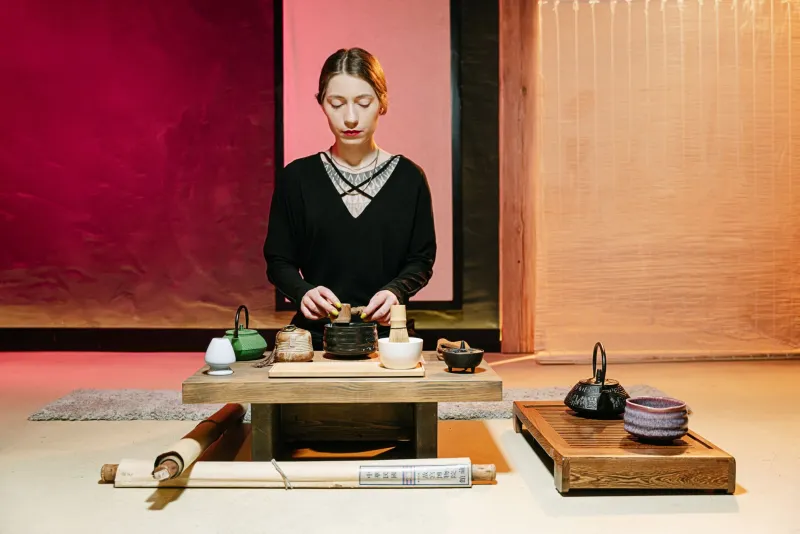
Second, consider introducing a mid-morning matcha preparation — not as a replacement for everything else, but as a sustained energy source that bridges the gap between morning alertness and afternoon productivity. The ritual of preparation itself, which we have written about extensively at Kagura Matcha, adds a dimension of intentional pause that many practitioners find valuable beyond the biochemical effects.
Third, pay attention to your evening sleep quality. Caffeine consumed after two in the afternoon has a measurable effect on sleep architecture for most adults, even when they feel they can fall asleep normally. Better sleep produces better cortisol rhythms the following morning, which reduces dependence on large caffeine doses — a genuinely virtuous cycle.
The Crash as Information
The three o'clock wall is not a character flaw or an inevitability. It is information. It is your body communicating something about the biochemical conditions you created earlier in the day.
Listening to that signal — and responding with something more precisely suited to your actual needs — is what distinguishes a thoughtful approach to energy management from the reflexive habit of reaching for whatever is nearest. Matcha, prepared with care and consumed with intention, offers one of the more structurally sound answers to that signal that modern nutrition science has to offer.
The afternoon, it turns out, does not have to be something you survive. It can be something you move through with the same clarity you brought to the morning.