Your Matcha Moment: Building a Mindful Daily Practice That Works in the Real World
The Gap Between Ceremony and Reality
Most Americans who discover matcha do so through a wellness article, a specialty café, or a friend's enthusiastic recommendation. They read about the Japanese tea ceremony — chado, the Way of Tea — and feel genuinely inspired by its emphasis on presence, simplicity, and the transformative potential of a single mindful act. Then they look at their actual morning: the alarm that went off twice, the inbox already filling up, the commute that does not forgive slowness.
The ceremony feels beautiful and impossibly distant at the same time.
Here is what that gap misses: chado was never intended to be a performance reserved for special occasions. Its foundational philosophy, distilled through the teachings of the 16th-century tea master Sen no Rikyu, centers on the concept of ichi-go ichi-e — roughly translated as "one time, one meeting." The idea is that each moment of tea preparation and sharing is unrepeatable, and therefore worthy of full attention. That principle does not require a formal setting. It requires only a willingness to show up, briefly and completely, for what you are doing.
Building a personal matcha ritual is not about replicating ceremony. It is about borrowing its underlying intention and making it yours.
What a Ritual Actually Does for You
Before designing your own practice, it is worth understanding why rituals work — not just as pleasant habits, but as genuine psychological tools.
Behavioral researchers have found that brief, consistent rituals reduce anxiety around performance tasks, increase focus by signaling a transition between mental states, and enhance the subjective enjoyment of an experience. The ritual functions as a kind of cognitive bookmark: it tells the brain that something different is about to happen, creating a mental clearing that ordinary habit does not provide.
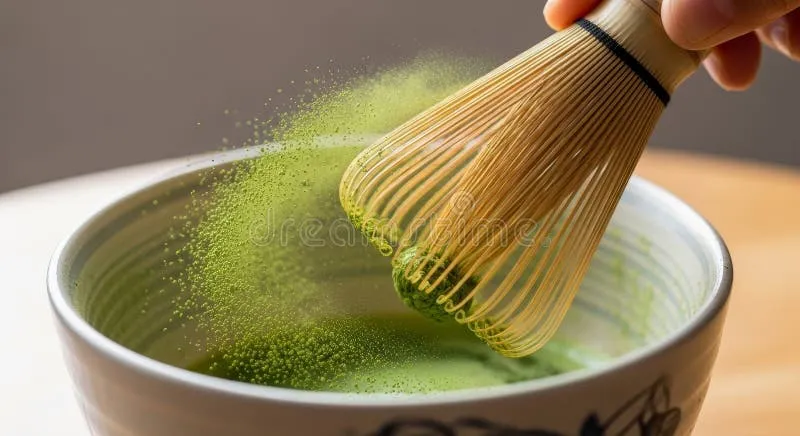
For matcha specifically, the preparation process itself — measuring, sifting, whisking — is tactile, sensory, and just complex enough to occupy the mind without overwhelming it. This is not accidental. The tools of the tea ceremony (chakin, chasen, chawan) were designed over centuries to make the process of preparation as deliberately engaging as the act of drinking. When you hold a chasen (bamboo whisk) and move it in deliberate figure-eight strokes through warm, fragrant matcha, you are participating in a physical practice that has been refined for exactly this purpose: to pull attention into the present moment.
Framework One: The Morning Anchor
For many people, the most valuable place to install a matcha ritual is at the beginning of the day, before the reactive demands of work and family take hold. This does not require waking earlier — it requires protecting a window of five to ten minutes that already exists between rising and beginning your obligations.
The Morning Anchor ritual is intentionally minimal:
Prepare your space the night before. Set your matcha bowl, whisk, and scoop on the counter before bed. This small act of preparation eliminates morning friction and signals, even subconsciously, that something worth anticipating is waiting for you.
Heat water without distraction. While water heats to approximately 170°F, resist the phone. Look out a window. Notice the quality of light. This is not wasted time; it is the beginning of the ritual.
Sift and whisk with deliberate slowness. Sift 1.5 to 2 grams of ceremonial-grade matcha into your bowl. Add a small amount of warm water first and work the powder into a smooth paste before adding the remainder. Whisk in brisk, controlled strokes until a fine foam forms at the surface. The entire process takes under three minutes.
Drink before checking anything. Sit. Hold the bowl with both hands — the traditional gesture of receiving something of value. Take three or four unhurried sips before your day officially begins.
This sequence works precisely because it is finite and repeatable. The brain learns to associate the scent of warming matcha with the transition into intentional wakefulness rather than reactive urgency.
Framework Two: The Midday Reset
America's relationship with the lunch break is, to put it charitably, complicated. Many professionals eat at their desks, scroll through their phones, or simply skip the break entirely. The cognitive cost of this pattern is well-documented: sustained attention deteriorates sharply without genuine rest intervals, and decision quality declines measurably through the afternoon.
A midday matcha ritual does not require leaving your workplace. It requires approximately eight minutes and a small dedicated kit — a travel tin of matcha, a compact electric frother or travel whisk, a simple ceramic cup, and a portable electric kettle if your office allows it.
The Midday Reset is less about elaborate preparation and more about deliberate transition. Step away from your screen. Prepare your matcha with the same measured attention you would give it at home. Drink it standing by a window if possible, or seated somewhere that is not your primary work station. The physical relocation, however modest, reinforces the psychological break.
This is the modern equivalent of the tea break that remains culturally embedded in British and Japanese professional life — and the research on restorative microbreaks strongly supports its practical value.
Framework Three: The Evening Transition
Matcha is not exclusively a morning beverage, though its caffeine content does make timing relevant. For the evening, consider a lower-concentration preparation — approximately one gram of matcha in a slightly larger volume of water — which delivers meaningful L-theanine content (with its documented relaxation-supporting properties) while minimizing caffeine's potential to interfere with sleep.
The Evening Transition ritual works best as a deliberate marker between the working day and personal time. The act of preparing matcha — slow, quiet, requiring gentle attention — serves as a decompression sequence rather than a stimulant. Pair it with the deliberate absence of screens for the duration of drinking, and you have created a small but effective buffer between professional stress and the rest of your evening.
Some Kagura Matcha customers find that incorporating a single written reflection — one sentence about something that went well that day — into this ritual amplifies its psychological benefit considerably.
Personalizing Without Losing the Thread
The three frameworks above are starting points, not prescriptions. Your ritual should evolve to reflect your space, your schedule, and what genuinely feels meaningful to you. Some people incorporate music; others prefer complete silence. Some prepare matcha in a traditional chawan; others use a simple ceramic mug that has personal significance.
What matters is consistency and intention — not equipment or performance. The spirit of ichi-go ichi-e is not about doing things correctly. It is about doing this particular thing, right now, as if it were the only time you ever would.
That is a practice available to anyone, in any kitchen, on any morning — however imperfect the circumstances surrounding it might be. Start there. The ritual will find its shape over time.