Beyond the App: How the Ancient Practice of Matcha Preparation Quiets Anxiety More Effectively Than Digital Meditation
The Limits of the Screen-Based Solution
In the United States, anxiety disorders affect more than 40 million adults, making them the most prevalent mental health concern in the country. Against this backdrop, the meditation app industry has exploded into a multi-billion-dollar market, promising relief through guided breathing, body scans, and ambient soundscapes delivered through a smartphone. The appeal is obvious: convenience, portability, and the reassuring sense that help is always one tap away.
Yet a quieter movement is gaining momentum among wellness practitioners, therapists, and mindfulness educators — one that trades the glowing screen for a ceramic bowl, a bamboo whisk, and a few grams of finely milled Japanese matcha. The question worth asking seriously is not whether meditation apps have value, but whether the ritualized preparation of matcha may engage the nervous system in ways that passive, technology-mediated practices simply cannot replicate.
The answer, as neuroscience is beginning to illuminate, has everything to do with how the human brain responds to intentional action, sensory immersion, and structured repetition.
What Ritual Does to the Anxious Brain
Anxiety, at its neurological core, is often a problem of prediction. The brain's threat-detection system — centered in the amygdala — generates distress when the future feels uncertain or uncontrollable. Cognitive behavioral therapists have long understood that one of the most effective antidotes to this state is the restoration of perceived agency: the felt sense that one's actions have reliable, meaningful consequences.
This is precisely where ritual earns its neurological credentials. Research published in the journal Psychological Science found that ritualistic behavior — defined as actions performed in a fixed, sequential order with focused attention — measurably reduced anxiety before high-stakes performance tasks. The mechanism appears to involve the prefrontal cortex, which governs executive function and emotional regulation. When the brain is engaged in a structured sequence of purposeful actions, it quite literally has less bandwidth available for rumination.
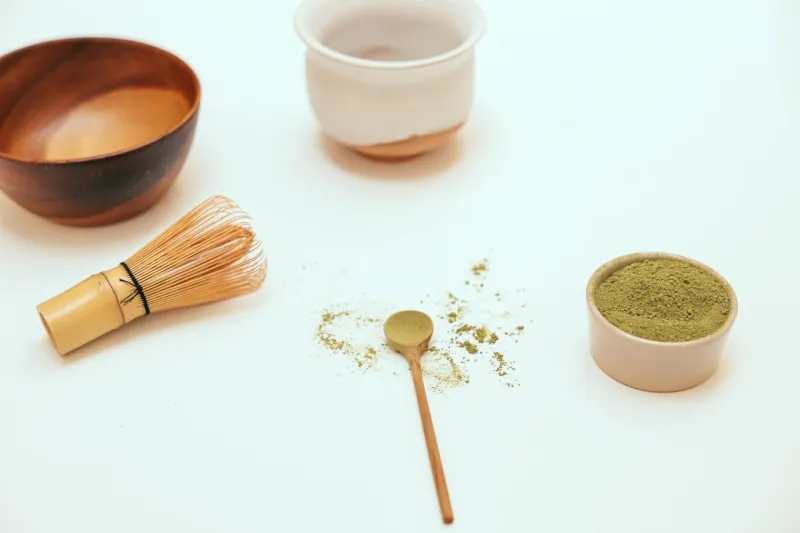
Preparing matcha according to traditional Japanese principles is, by any rigorous definition, a ritual of this kind. Each step — measuring the powder, sifting it through a fine-mesh strainer, heating water to precisely 175°F, pouring in a deliberate arc, whisking in a steady W-shaped motion — forms an unbroken chain of intentional micro-decisions. The practitioner is not passively receiving calm; they are actively constructing it, one movement at a time.
The Sensory Dimension That Apps Cannot Provide
Meditation apps are, by their nature, predominantly auditory experiences. A calming voice, a resonant bell, perhaps a visualization prompt — the engagement is largely confined to a single sensory channel while the body remains inert. This is not a trivial limitation.
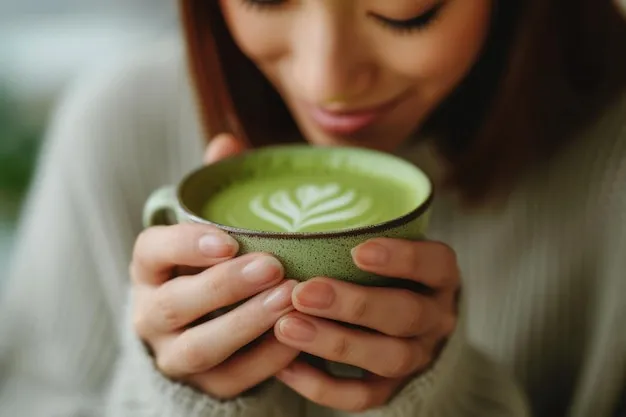
The preparation of matcha is a full-spectrum sensory event. The visual emerges first: the deep, almost geological green of ceremonial-grade powder settling into the bowl. Then sound — the soft percussion of the whisk against ceramic, the quiet rush of water. Scent follows immediately, that characteristic vegetal sweetness carrying notes of umami and fresh grass. Finally, touch: the warmth of the bowl cupped between both palms, a gesture that in Japanese ceremony is not incidental but deliberate, a physical act of receiving.
Neuroscientists refer to this kind of layered sensory engagement as "multisensory integration," and its effects on the stress response are well-documented. Engaging multiple sensory pathways simultaneously activates the parasympathetic nervous system — the branch responsible for the body's rest-and-digest state — more robustly than single-channel stimulation. The body, in other words, receives a more complete signal that it is safe.
L-theanine, the amino acid found in high concentrations in shade-grown Japanese matcha, compounds this effect biochemically. By promoting alpha-wave brain activity — the same neural signature associated with wakeful calm — L-theanine works in concert with the ritual itself, creating a physiological environment that supports anxiety reduction from the inside out.
Movement as Medicine: The Case for Embodied Practice
One of the more compelling arguments against passive meditation as a primary anxiety intervention is the growing body of evidence suggesting that the body needs to be involved, not merely still. Somatic therapists have long maintained that anxiety is stored in the body as much as in the mind, and that movement — even gentle, deliberate movement — is essential to its release.
The act of whisking matcha engages the practitioner's body in a way that sitting with headphones does not. The rhythmic, bilateral motion of the wrist — moving the chasen in that characteristic figure-eight pattern — bears a structural resemblance to EMDR (Eye Movement Desensitization and Reprocessing), a clinically validated therapy for anxiety and trauma that uses bilateral stimulation to reduce emotional distress. While matcha preparation is not a clinical intervention, the parallel is worth noting: repetitive, bilateral physical movement appears to have an inherent calming effect on the nervous system.
Several wellness coaches and integrative health practitioners working with clients in cities including New York, Los Angeles, and Chicago have begun incorporating matcha preparation into their practices for precisely this reason. The feedback, anecdotally, is consistent: clients who establish a daily matcha ritual report a more durable sense of groundedness than those who rely exclusively on app-guided sessions, particularly during periods of acute stress.
The Presence Problem With Apps
There is an irony embedded in the design of most meditation apps that is rarely acknowledged: they are delivered through the same device that is, for most users, the primary source of distraction, comparison, and digital overstimulation. Opening a calm, guided session on the same phone that holds social media notifications, work emails, and news alerts requires a significant act of compartmentalization — one that many users find genuinely difficult to sustain.
The matcha ritual demands a different kind of presence by its very structure. The equipment must be assembled. The water must be heated to a specific temperature. The powder must be measured. Each of these preparatory acts functions as a threshold — a gentle but firm invitation to leave the digital world behind and inhabit the physical one. The Japanese concept of ma, often translated as meaningful pause or negative space, is built into the ceremony's architecture. There is no skipping ahead, no notification to interrupt the W-shaped whisking motion.
This enforced deceleration is not a bug; it is the mechanism.
Building Your Own Anxiety-Regulating Practice
Adopting the matcha ritual as an anxiety management tool does not require mastery of the full Japanese tea ceremony, nor does it demand expensive equipment. What it does require is consistency and intentionality.
Begin with a quality ceremonial-grade matcha — the grade matters, both for flavor and for the L-theanine content that supports the neurochemical dimension of the practice. Designate a specific time and place: morning is particularly effective, as it establishes a regulated nervous system baseline before the day's demands accumulate. Assemble your tools — a bowl, a whisk, a small sifter — and treat their arrangement as the first act of the ritual, not a preamble to it.
Whisk slowly at first, then with more energy as the froth develops. Hold the bowl with both hands when you drink. Notice the temperature, the texture, the taste. Allow the entire sequence to take five minutes minimum. This is not wasted time. This is the practice.
The goal is not to replicate a centuries-old Japanese ceremony with perfect fidelity. It is to engage the brain's regulatory systems through intentional movement, multisensory immersion, and structured repetition — mechanisms that the screen in your pocket, however thoughtfully designed, was never built to provide.